
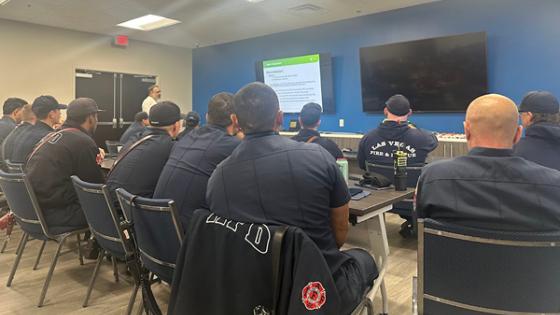
TRANSCAER LNG Safety & Emergency Response Training
1302 Chesapeake Avenue,
Curtis Bay, MD 21226
Open in Google Maps
Available Sessions:
- to EDT (Registration Closed)
- to EDT (Registration Closed)
- to EDT (Registration Closed)
Overview
Training includes:
- Classroom instruction
- Complimentary meal
- Student Manuals provided
- TRANSCAER Challenge Coins and Certificates upon successful completion of the session (certificates will be emailed following the event)
Attendee Level
- Technician Level
- Operations Level
- First responders
- Basic/Introduction
Event Focus
Featured Topic:
- Liquified Natural Gas (LNG)
Description
Gain an understanding of the basic safety and response considerations for emergencies involving the potential or actual release of liquefied natural gas.
- Module 1: Course Introduction
- Module 2: LNG Overview
- Understand the history, properties, and current use of Liquefied Natural Gas.
- Discuss the history and growth of LNG.
- Describe how LNG is produced.
- List the four most common uses of LNG.
- Explain the properties and characteristics of LNG.
- Identify key safety concerns of liquefied natural gas.
- Understand the history, properties, and current use of Liquefied Natural Gas.
- Module 3: LNG Safety & Transportation
- Identify the basic safety considerations concerning LNG containers and its various applications.
- Describe modes of LNG transportation and the use of LNG as a fuel.
- Identify the likelihood and potential locations of LNG incidents.
- Identify handling and safety considerations for LNG storage facilities.
- Identify resources available to provide product and mitigation information.
- Explain why LNG is used as a transportation fuel.
- List the most common LNG transportation modes.
- Identify the placards and markings for LNG.
- Describe general LNG container characteristics.
- Module 4: Managing LNG Incidents for Emergency Responders
- Identify the appropriate incident objectives for a safe and effective response.
- Identify important pre-incident planning considerations.
- Identify lessons learned from LNG incidents.
- Value the relationships between local, state, federal & industry response organizations.
- Identify the four components of hazard analysis and risk assessment.
- Given scenarios, identify appropriate defensive and offensive action options.
- Identify the appropriate incident objectives for a safe and effective response.
- Module 5: Post-Assessment & Course Evaluation
Important Details
Class is limited to 30 attendees per session. You must pre-register to attend.
Please be at the site by 8:00AM for registration. Class will begin promptly at 8:30AM EST. Depending on registration and training needs, the training schedule may be adjusted prior to event.
Please advise the instructor(s) of any pre-existing medical condition(s) that may preclude you from participating in any field exercise. Stay hydrated and alert.
Sponsors
- Center for Liquefied Natural Gas (CLNG)
- TRANSCAER
Event Contacts
Sawyer
Sanchez
CHEMTREC
Mobile 703-475-5470
ssanchez@chemtrec.com
3130 Fairview Park Drive, FL 4
Falls Church VA 22042
Mobile 703-475-5470
ssanchez@chemtrec.com
Kevin
Ryan
Baltimore City FD Hazmat Operations
Mobile 4433093649
kevin.ryan@baltimorecity.gov
34 Blue Spruce Way
Elkton MD 21921
Mobile 4433093649
kevin.ryan@baltimorecity.gov
In-Person Training Events
Enhance emergency response preparedness with free, expert-led in-person and virtual hazmat training courses.

More Training Options
Choose the training method that works for your team—from online courses and on-site exercises to apps and videos.

Training Resources
Explore additional hazmat resources, including commodity flow studies, AskRail, TRIPR, SERTC, and more.